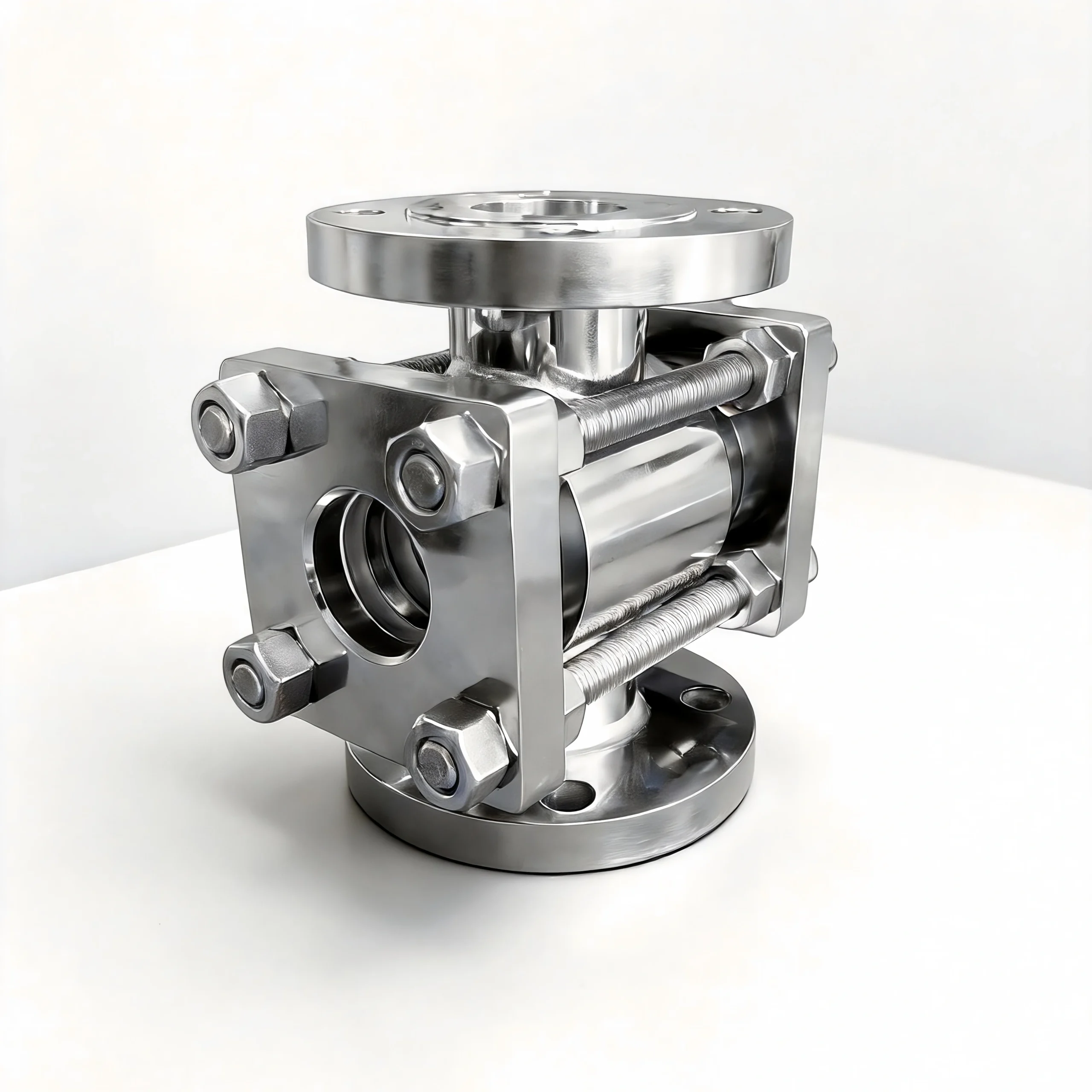
Sight Flow Indicator with Rotor | ASME B16.5 | Lumiglas
Extreme-service flanged sight flow indicator with 316SS rotor. ANSI/ASME B16.5 Class 150/300, dual window, customizable body, seal & coating. EN 10204 3.1 certified.
Description
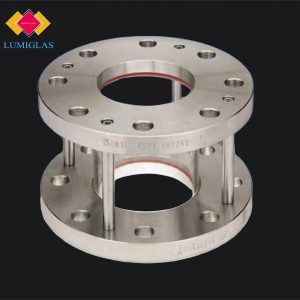
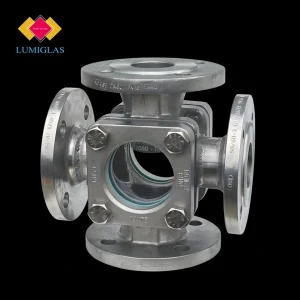
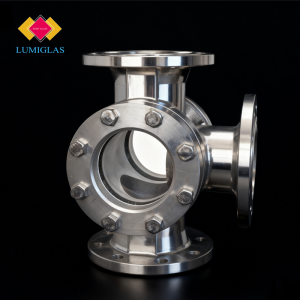
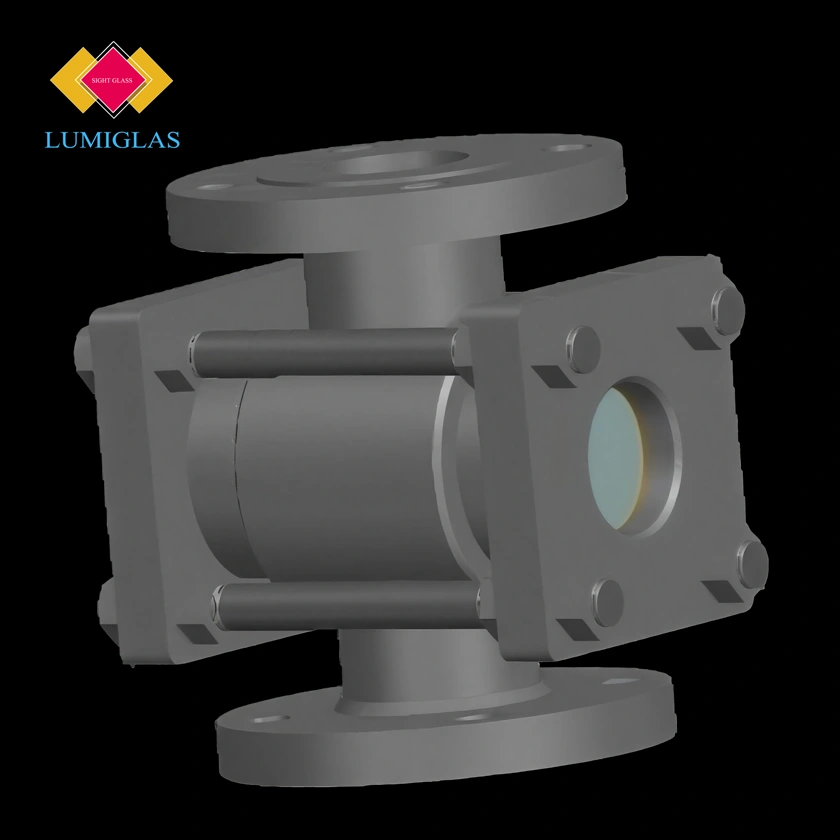
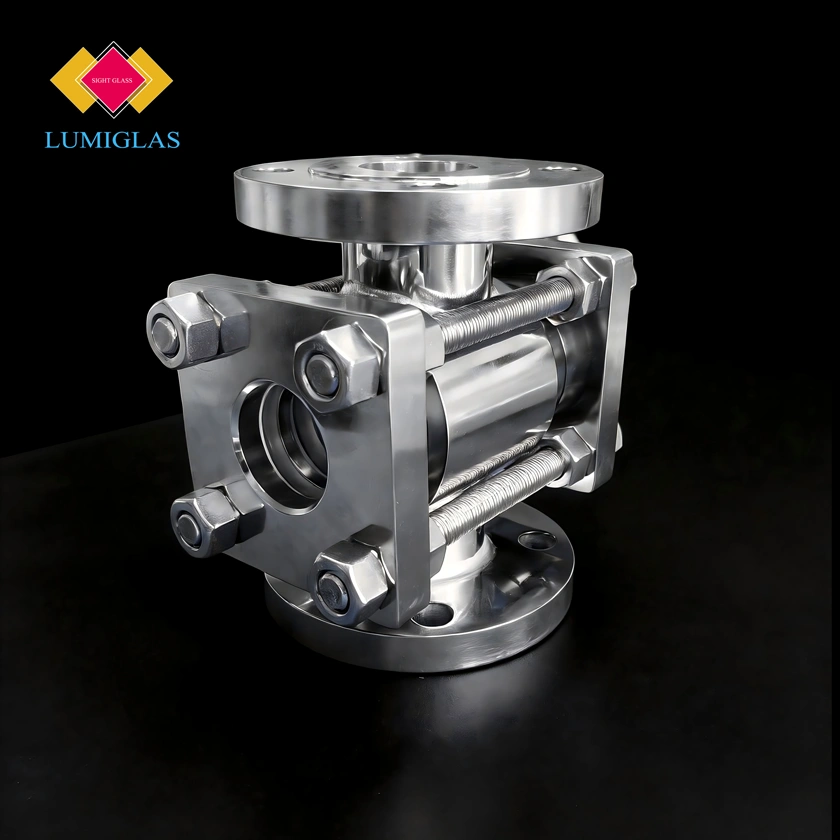
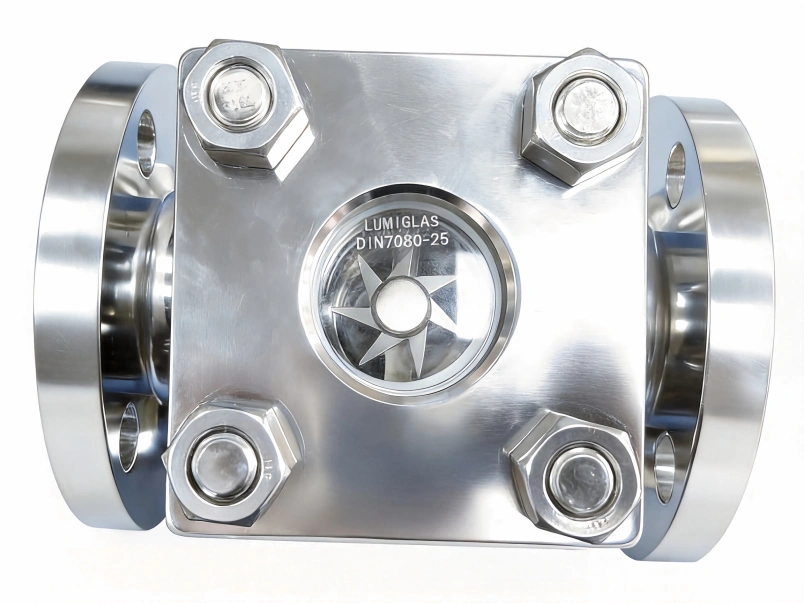
A sight flow indicator with rotor is a flanged, dual-window in-line device that lets operators visually confirm flow, direction and product condition in a process pipeline. Specifically, a rotor (spinner) sits in the flow path and turns whenever medium passes through, giving an immediate, power-free indication of flow — even at low rates — while twin borosilicate windows show the colour, clarity and phase of the medium directly. As a result, process engineers specify this rotary sight flow indicator for pumps, dosing skids and transfer lines wherever they need a fast, mechanical flow check.
Lumiglas engineers the LMX 880-XR flanged sight flow indicator for extreme-service duty. Unlike a standard catalogue sight glass that tops out at 400 °F / 232 psi, the LMX 880-XR ships configured per order: you select the body material, glass, seal and external coating, so a single design platform handles aggressive chemicals, cryogenic and high-temperature media, offshore atmospheres and hygienic pharmaceutical service. Moreover, flange connections follow ANSI / ASME B16.5 (Class 150 and Class 300), and every unit ships with EN 10204 3.1 material certification and a hydrostatic test. Furthermore, our sight glass assemblies carry PED 2014/68/EU approval, and the company holds ISO 9001, ISO 14001, ISO 45001, EJ/T 9001 (nuclear) and EAC certification — backed by a proven track record on FPSO and offshore programmes for operators such as MODEC / Shell, CIMC Raffles, Yinson and CNPC.
Sight flow indicator with rotor — quick facts
- Type: Flanged dual-window sight flow indicator with rotor (spinner) indication
- Flange standard: ANSI / ASME B16.5 · Class 150 & Class 300 · RF standard, RTJ optional
- Nominal size range: DN15 – DN200 (½” – 8″)
- Body material (customizable): 316/316L SS (default) · carbon steel · duplex · Hastelloy · titanium on request
- Windows: Tempered borosilicate, DIN 7080 (dual, view-through)
- Seal (customizable): PTFE (default) · graphite · FKM / FFKM
- Indication: 316 SS rotor · flapper / drip-nose optional
- External coating (customizable): standard · offshore multi-coat system · custom RAL
- Certification & test: EN 10204 Type 3.1 · hydrotest at 1.5 × design pressure
- Approvals: PED 2014/68/EU · ISO 9001 · ISO 14001 · ISO 45001 · EJ/T 9001 (nuclear) · GJB 9001C (military) · EAC
- Track record: FPSO & offshore supply — MODEC/Shell, CIMC Raffles, Yinson, CNPC, CSIC
- Industries: pharmaceutical · chemical · petrochemical · oil & gas · offshore & marine
How a sight flow indicator with rotor works
Process medium enters the body bore and passes the rotor, which sits on a shaft between the two window assemblies. As the medium flows, it spins the rotor; the operator then reads flow presence and approximate rate from the rotation speed through either window. Because indication stays purely mechanical and visual, the device needs no electrical supply and adds no failure modes to the process. In addition, the rotor style works in any mounting position and with any flow direction, and stays visible with both clear and dark fluids.
The optional drip-nose (drip-tube) variant additionally reveals the smallest drip-wise flow rates, which suits it to leak-down checks and low-throughput dosing lines. However, at very low flow rates the rotor may not turn — so for those services we recommend a drip-nose or flapper configuration instead.
Construction & bill of materials
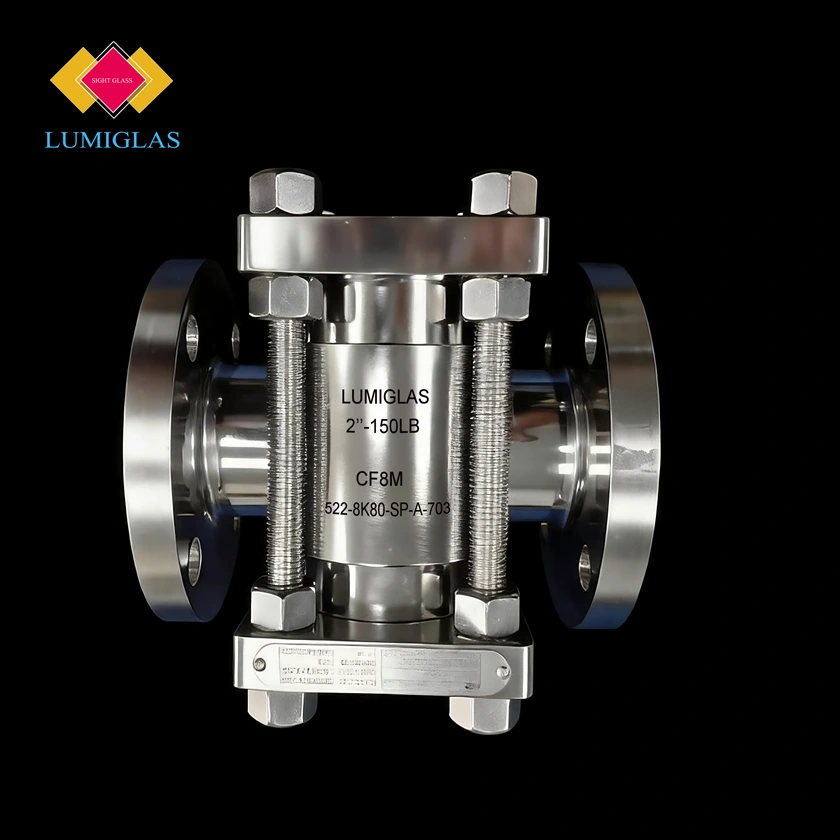
The unit is a bolted assembly of a central flanged body, two cover flanges that carry the borosilicate windows, the rotor sub-assembly, and the associated gaskets, studs and nuts. The table below lists the default material for each part; however, you can select every wetted material — see the materials section that follows.
| Item | Part | Qty | Standard Material | Grade / Notes |
|---|---|---|---|---|
| 01 | Body | 1 | 316 SS (cast) | ASTM A351 Gr. CF8M |
| 02 | Cover | 2 | 316 SS (cast) | ASTM A351 Gr. CF8M |
| 03 | Window (Lens) | 4 | Tempered borosilicate | DIN 7080 · max. 260 °C (500 °F) |
| 04 | Gasket | 8 | PTFE | Max. 177 °C (350 °F); graphite optional |
| 05 | Studs | 4 | 316 SS | ASTM A193 Gr. B8M2 |
| 06 | Nuts | 16 | 316 SS | ASTM A194 Gr. 8M |
| 07 | Rotor | 1 | 316 SS | Spinner-type flow indicator |
| 08 | Retainer | 2 | 316 SS | ASTM A351 Gr. CF8M |
Materials of construction (customizable)
The LMX 880-XR platform accepts a wide range of body, window and seal materials, so the same design matches the chemistry, temperature and mechanical demands of each service. The table lists common selections; in addition, we supply other alloys on request.
Body & pressure-retaining parts
| Material | Cast Grade | Forged Grade | Typical Use |
|---|---|---|---|
| Carbon steel | ASTM A216 WCB | ASTM A105 | General hydrocarbon & utility service |
| 316 / 316L SS | A351 CF8M / CF3M | A182 F316 / F316L | Corrosive chemical & pharmaceutical (default) |
| 304 / 304L SS | A351 CF8 / CF3 | A182 F304 / F304L | Mild corrosive & general stainless service |
| Duplex 2205 | ASTM A995 4A | ASTM A182 F51 | Chloride-bearing & offshore service |
| Alloy / special | On request | On request | Hastelloy, titanium, Monel, etc. |
Windows & seals
| Component | Selection | Temperature Limit | Notes |
|---|---|---|---|
| Window | Borosilicate (DIN 7080) | ≤ 280 °C (536 °F) | Default; high thermal & chemical resistance |
| Window | Soda-lime (DIN 8902) | ≤ 150 °C (302 °F) | Economical, lower-duty service |
| Seal | PTFE | ≤ 177 °C (350 °F) | Default; broad chemical compatibility |
| Seal | Graphite (armoured) | ≤ 450 °C (842 °F) | High-temperature service |
| Seal | FKM / FFKM | Per compound | Aggressive chemical / hygienic duty |
Pressure–temperature ratings (ASME B16.5)
The flange class (150, 300) is a dimensionless designation, not a fixed pressure. Instead, the maximum allowable working pressure depends on the body material group and the operating temperature, and the glass and seal limit it further. The tables below come directly from the ASME B16.5 rating tables (values as psig / bar g).
⚠ Note: Legacy “16 bar at 150 lb / 40 bar at 300 lb” figures are PN-class equivalents, not the correct ASME B16.5 ratings. Always select the class from design pressure, design temperature and body material group, and confirm against the controlling project specification.
316 / 316H stainless body (A351 CF8M / A182 F316)
| Temp. °C (°F) | Class 150 (psig / bar) | Class 300 (psig / bar) | Class 600 (psig / bar) |
|---|---|---|---|
| −29 to 38 (−20–100) | 275 / 19.0 | 720 / 49.6 | 1440 / 99.3 |
| 93 (200) | 235 / 16.2 | 620 / 42.7 | 1240 / 85.5 |
| 149 (300) | 215 / 14.8 | 560 / 38.6 | 1120 / 77.2 |
| 204 (400) | 195 / 13.4 | 515 / 35.5 | 1025 / 70.7 |
| 260 (500) | 170 / 11.7 | 480 / 33.1 | 955 / 65.8 |
| 316 (600) | 140 / 9.7 | 450 / 31.0 | 900 / 62.1 |
316 stainless ratings fall below carbon steel above ambient temperature. For reference, carbon steel (A216 WCB / A105) Class 150 carries ~285 psig / 19.7 bar at ambient. The product manual gives the full carbon-steel and stainless tables to 800 °F.
Dimensions (ASME B16.5, ½” – 8″)
Flange geometry follows ASME B16.5. D = flange OD (per class); BL = face-to-face build length; d₁ = clear viewing bore; d₂ = glass diameter; S = glass thickness. All dimensions in mm; confirmed on the certified order drawing.
| Size | D Cl.150 | D Cl.300 | BL | d₁ | d₂ | S 16bar | S 40bar |
|---|---|---|---|---|---|---|---|
| ½” | 89 | 95.2 | 130 | 32 | 45 | 10 | 10 |
| ¾” | 98 | 117.3 | 150 | 32 | 45 | 10 | 10 |
| 1″ | 108 | 123.8 | 160 | 48 | 63 | 10 | 15 |
| 1½” | 127 | 155.6 | 200 | 65 | 80 | 12 | 20 |
| 2″ | 152 | 165.1 | 230 | 80 | 100 | 15 | 25 |
| 3″ | 191 | 209.6 | 310 | 100 | 125 | 20 | 30 |
| 4″ | 228 | 254.0 | 350 | 125 | 150 | 25 | 32 |
| 6″ | 279 | 317.5 | 480 | 175 | 200 | 30 | o.r. |
| 8″ | 343 | 381.0 | 600 | 175 | 200 | 30 | o.r. |
o.r. = glass thickness on request. Reference drawing (2″ Class 150): dimensional drawing (PDF).
Applications & industries
Process engineers specify the LMX 880-XR wherever they must confirm flow or observe product condition under demanding conditions — in particular where a standard 400 °F sight glass would fail on material or coating grounds.
- Pharmaceutical
- Chemical Processing
- Petrochemical
- Oil & Gas / Refining
- Offshore & Marine
- Water Treatment
- Power Generation
Typical services
- Flow / no-flow confirmation on pumps, dosing skids and transfer lines — the rotor gives a clear visual cue from a distance.
- Product observation — colour, clarity, phase separation and entrained gas or solids through the dual windows.
- Low-rate & drip-wise detection via the optional drip-nose, for distillation and low-throughput dosing.
- Corrosive & offshore duty — with duplex/alloy bodies and heavy-duty external coating for petrochemical and marine environments.
Installation
⚠ Flow direction: Observe the flow-direction arrow on the body. The rotor style works in any position and any direction, but the arrow must match the line flow for correct reading.
- Check orientation: Confirm the flow-direction arrow on the body matches the pipeline flow. For the clearest rotor indication, mount the unit in a vertical line with upward flow; alternatively, mount it horizontally where the drawing allows.
- Fit gaskets: Use clean, undamaged gaskets of the specified material. Do not reuse compressed gaskets.
- Tighten evenly: Tighten studs in a diametrically opposed (cross) pattern to the specified torque. Uneven or excessive bolt load causes most glass fractures, so torque carefully.
- Protect the glass: Avoid mechanical impact and sudden temperature changes (thermal shock) across the windows.
- Commission: Confirm free rotor movement under normal flow. If the rotor does not turn at very low flow, switch to a drip-nose or flapper configuration.
Inspection, testing & certification
- Material certification: EN 10204 Type 3.1 for pressure-retaining parts.
- Hydrostatic test: each assembly hydrotested at 1.5 × design pressure (reference unit: 29.4 barg for 60 minutes).
- NDE: performed per the applicable project specification where required.
- Marking & nameplate: per MSS SP-25; SS316 nameplate, project tag deeply die-stamped.
Ordering information
To configure an LMX 880-XR unit, specify: nominal size (½”–8″), pressure class (150 / 300), flange facing (RF / RTJ), body material, window glass, gasket/seal, indicator type (rotor / flapper / drip-nose), external coating, and the service conditions (design pressure, design temperature, medium, atmosphere). Lumistar engineering confirms the selection and issues a certified drawing.
Certifications & approvals
Lumiglas manufactures every sight flow indicator under a fully certified quality system. Notably, LRQA approves our sight glass assemblies for pressure purpose under the EU Pressure Equipment Directive (PED 2014/68/EU, Annex I §4.3) up to DN200 (8″) and PN160 (Class 900LB), and the company also holds nuclear-industry and military quality certifications. As a result, the assemblies meet the documentation requirements of pressure-vessel manufacturers, EPC contractors, and nuclear and defence suppliers. Third parties issue every certificate number below, so you can verify each one independently.
| Standard / Scheme | Scope | Body / Cert. No. | Validity |
|---|---|---|---|
| PED 2014/68/EU | Sight glass assembly for pressure purpose (Annex I §4.3), up to DN200 / PN160 | LRQA (NB 0343) · 0343/PEDM/BJG00003063/A | 2026-05-10 → 2029-05-09 |
| ISO 9001:2015 | Quality management — sight glass, gauge glass, viewport production | Bureau Veritas (UKAS 0008) · CN059120 | 2026-02-10 → 2029-02-09 |
| ISO 14001:2015 | Environmental management system | Xingyuan (CNAS C035-M) · 03525E0859R301 | 2025-11-25 → 2028-11-24 |
| ISO 45001:2018 | Occupational health & safety management | Xingyuan (CNAS C035-M) · 0350725S30006R0S | 2025-01-17 → 2028-01-16 |
| EJ/T 9001:2014 | Nuclear-industry quality management | Xingyuan · 03525EJ0050R200 | 2025-11-27 → 2028-11-24 |
| GJB 9001C:2017 | Military quality management system | Certified | Current |
| EAC · TR TS 010/2011 & 032/2013 | EAEU conformity — industrial pipeline sight glass (½”–8″, Class 150–900LB) | EAEU declaration & type certificate | to 2030 |
The PED schedule covers forged flanges (A105, A182 F304/F316/F310/F51/F904L, LF2), fasteners (A193/A194 B7/B8M, duplex S32205/S32750) and sight glass (DIN 7080/7081/8902, borosilicate, alkali-resistant, aluminosilicate, quartz, sapphire). Full certificate scans are on the certifications page.
Offshore & FPSO project references
Flagship FPSO & offshore projects
Lumiglas supplies sight glass and sight flow indicators to major FPSO, offshore and deep-sea programmes worldwide. Specifically, the reference projects below show qualification with international operators and EPC/module fabricators to ASME B16.5, API 6A and DIN standards — under some of the most demanding temperature and pressure conditions in the industry.
| Client / End User | Project / Application | Specification | Duty | Country |
|---|---|---|---|---|
| MODEC Inc. / Shell Brasil | Gato do Mato FPSO — piping-component sight glass | ASME B16.5 / API 6A, Class 150–2500 RF | Per process | Brazil |
| CIMC Raffles Offshore | FPSO / offshore platform module fabrication — qualified supplier | ASME / DIN / custom per vessel spec | Up to 350 °C / 35 MPa | China |
| Jord Intl. / First E&P / Yinson | Abigail Joseph FPSO (NAG Project) | ASME / API per requisition | Per process | Nigeria |
| CNPC Bohai Drilling | Offshore drilling equipment — Bohai Sea | ASME / API high-pressure pipe sight glass | 35 MPa | China |
| CSIC 702 Institute | Submarine / deep-sea pressure equipment | Alkali-resistant HP sight glass (100 MPa rated) | −70 °C to 1350 °C / 100 MPa | China |
| Findlytic Pte Ltd | 1″ & 1.5″ flow sight glass (DN25/DN40) | DN25/DN40 PN10 | 280 °C / 1 MPa | Singapore |
Wider industry track record
Beyond offshore, Lumiglas serves a broad international base across process and energy industries — for example Siemens (India & China), Shanghai Morimatsu (pharmaceutical/bioreactor), HISAKA WORKS, Toyota Industrial Equipment, Ma’aden (Saudi Arabia), CEYHAN PDH-PP plant (Turkey), INFN Legnaro (Italy) and multiple CNPC drilling research institutes. Consequently, our deliveries span power-plant boilers, petroleum machinery, pharmaceutical reactors, deep-well drilling and defence R&D, at conditions up to 1500 °C and 100 MPa.
About Lumiglas — manufacturer expertise
Lumistar Special Glass Technology Co., Ltd. (Lumiglas® brand) is a specialist industrial glazing and sight glass manufacturer in Nanjing, China. Our portfolio covers flanged sight flow indicators, sight glasses to DIN 7080 / DIN 7081, high-temperature glass-ceramic IGUs, and quartz and sapphire viewports for pressure vessels, furnaces, pipelines, reactors and marine equipment. We design every product to international standards (ASME B16.5, PED 2014/68/EU, DIN 7080) and ship worldwide with full material traceability. For current third-party records, see our certifications page.
Frequently asked questions
Product & operation
How does a sight flow indicator with rotor work?
Process medium passes a rotor (spinner) that sits in the flow path between two windows. The flow then spins the rotor, and the operator reads flow presence and approximate rate from the rotation speed through either window. Because indication stays purely mechanical and visual, the device needs no electrical power. In addition, the rotor style works in any mounting position and with any flow direction, and stays visible with clear or dark fluids.
What is the difference between a sight flow indicator and a sight glass?
In short, a sight glass is a plain window that lets you see into a pipe or vessel. A sight flow indicator, however, adds an indication element — a rotor, flapper or drip-nose — that moves with the flow, so it confirms not just visibility but flow presence, direction and approximate rate. For example, the LMX 880-XR is a rotor-type sight flow indicator with dual view-through windows.
Which way should a sight flow indicator with rotor face?
Install the unit so the flow-direction arrow on the body matches the pipeline flow. The rotor style operates in any position and any direction; however, a vertical line with upward flow gives the clearest rotor indication. For very low flow rates, where a rotor may not turn, choose a drip-nose or flapper configuration instead.
Performance & customization
What pressure and temperature can it handle?
The mechanical envelope follows ASME B16.5 by material and temperature — for a 316SS body, Class 150 carries 275 psig / 19.0 bar at ambient, dropping to 140 psig / 9.7 bar at 316 °C. Class 300 and Class 600 rate higher. In practice, the glass (borosilicate ≤ 280 °C) and seal (PTFE ≤ 177 °C, graphite ≤ 450 °C) set the actual service window, whichever comes lowest. Remember that the class is a designation, not a fixed bar value.
Can the body material and coating be customized?
Yes. We supply the body in carbon steel, 316/316L, 304/304L, duplex 2205, or special alloys such as Hastelloy and titanium. Furthermore, you choose the seals (PTFE, graphite, FKM/FFKM), the glass (borosilicate or soda-lime) and the external coating system (standard, offshore multi-coat, or custom RAL) per order, so the unit suits extreme chemical, cryogenic, high-temperature or offshore service.
Sizing, certification & references
What sizes and flange classes are available?
Nominal sizes range from DN15 to DN200 (½” to 8″), in ASME B16.5 Class 150 and Class 300, with raised-face (RF) standard and ring-type-joint (RTJ) optional. Custom sizes and facings are available on request; contact us with your line size, pressure class and service conditions for a project-specific quote.
Is the sight flow indicator certified for pressure equipment?
Yes. LRQA (Notified Body 0343) approves our sight glass assemblies for pressure purpose under the EU Pressure Equipment Directive (PED 2014/68/EU, Annex I §4.3), certificate 0343/PEDM/BJG00003063/A, covering sizes up to DN200 (8″) and PN160 (Class 900LB). In addition, the company holds ISO 9001:2015 (Bureau Veritas, CN059120), ISO 14001:2015, ISO 45001:2018, EJ/T 9001:2014 (nuclear industry), GJB 9001C:2017 (military) and EAC (EAEU) conformity for industrial pipeline sight glass.
Do you have offshore / FPSO supply experience?
Yes. Lumiglas is a qualified sight glass supplier on major FPSO and offshore programmes, including MODEC / Shell Brasil (Gato do Mato FPSO), Jord / First E&P / Yinson (Abigail Joseph FPSO, Nigeria) and CIMC Raffles offshore module fabrication, plus deep-sea and drilling projects for CNPC and CSIC (702 Institute) rated to 100 MPa. Supply is to ASME B16.5, API 6A and DIN standards per each vessel or project specification.
Downloads & technical documentation
Download the full product manual and dimensional drawing, or send us your size, pressure class, body material and service conditions for a direct quotation.