High-Temperature Explosion-Proof Glass — Glass-Ceramic Insulating Glazing Unit (IGU)
Lumiglas glass-ceramic IGU: NEG Neoceram + tempered safety glass. Continuous 950 °C service, 800 °C thermal shock, near-zero expansion. PED 2014/68/EU certified.
Description
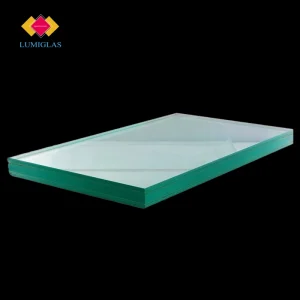
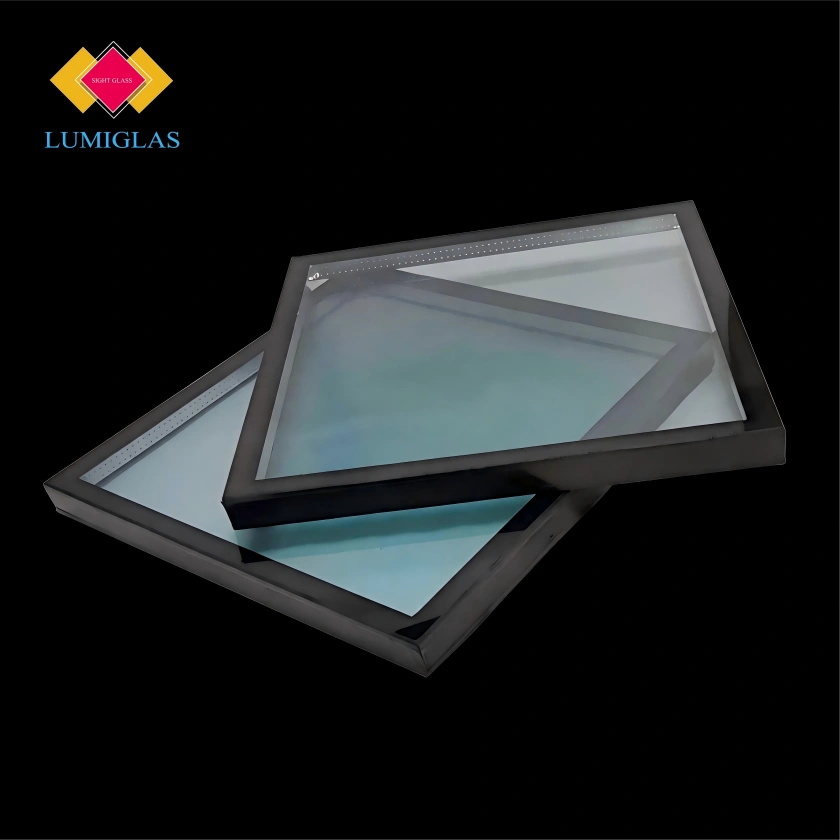
High-temperature explosion-proof glass is a composite glazing assembly that combines a transparent glass-ceramic inner pane with a thermally toughened safety glass outer pane, separated by an insulating air or argon cavity. Specifically, the glass-ceramic layer faces the heat source and resists continuous service temperatures up to 950 °C, while the toughened outer pane reduces external surface temperature and provides explosion-resistant mechanical protection. As a result, engineers specify this glass-ceramic insulating glazing unit (IGU) for furnace observation windows, kiln viewing panels, industrial oven doors and any application requiring clear visibility under extreme thermal load.
The Lumiglas glass-ceramic IGU uses NEG Neoceram® transparent glass-ceramic as the heat-facing pane, paired with thermally toughened safety glass on the cold side and a 16 mm aluminium spacer. Because the glass-ceramic exhibits near-zero thermal expansion (−1 × 10⁻⁷/K across 0–750 °C), the assembly withstands rapid thermal cycling without cracking. Moreover, in the event of fracture, the glass-ceramic breaks into safe fragments rather than projectile shards — therefore satisfying explosion-proof requirements for industrial pressure and combustion equipment. Production is certified to PED 2014/68/EU, ISO 9001:2015, GJB 9001C:2017 and EJ/T 9001:2014.
Glass-ceramic IGU — quick facts
- Construction: 5 mm NEG Neoceram glass-ceramic (hot side) + 16 mm aluminium spacer + 6 mm tempered safety glass (cold side)
- Continuous service temperature: ≤ 950 °C
- Short-term peak temperature: ≤ 1000 °C
- Thermal shock resistance: 800 °C (110 °C heated → 10 °C water quench, no cracks)
- Thermal expansion (0–750 °C): −1 × 10⁻⁷/K — virtually zero
- Flexural strength: 170 MPa (Neoceram)
- Vickers hardness: 700 HV
- Standard unit size: 1120 × 1120 × 27 mm — custom sizes on request
- Explosion behaviour: safe-fragment fracture, no projectile shards
- Certifications: PED 2014/68/EU · ISO 9001:2015 · ISO 14001:2015 · GJB 9001C:2017 · EJ/T 9001:2014
Glass-ceramic IGU construction
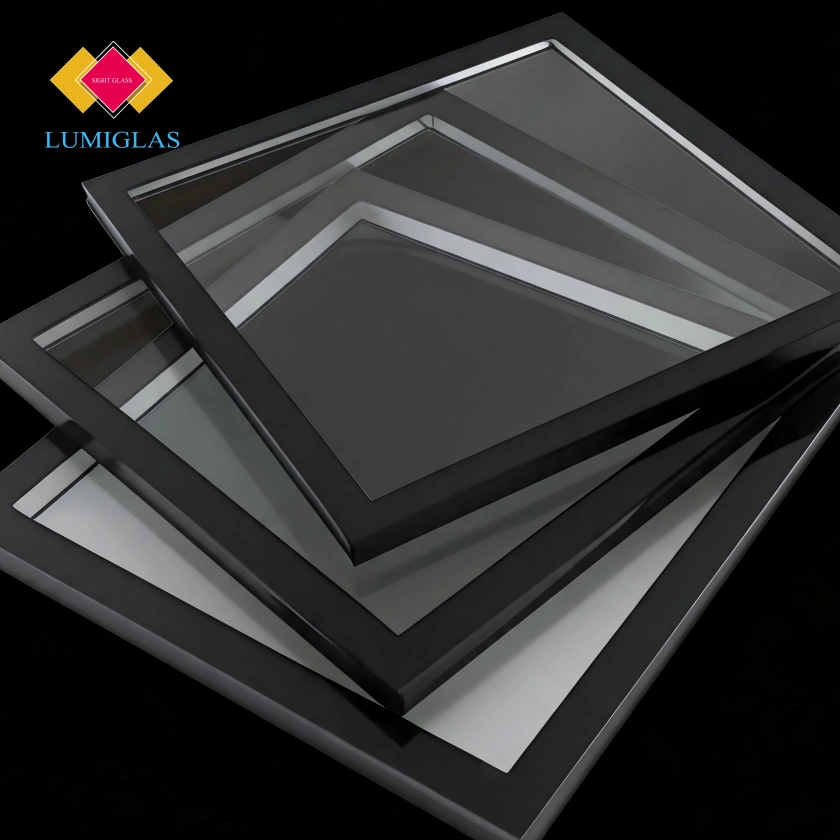
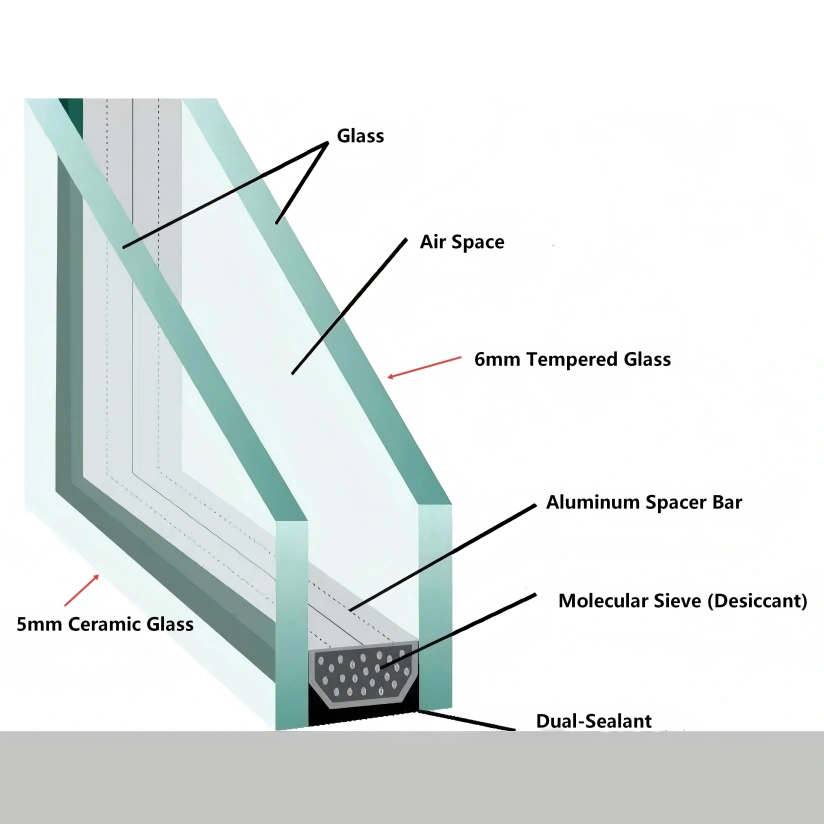
The Lumiglas high-temperature explosion-proof IGU is a three-layer composite assembly. Specifically, the hot-side glass-ceramic faces the heat source and absorbs the thermal load, the air or argon cavity blocks heat transfer, and the cold-side tempered glass reduces operator-side surface temperature while adding mechanical protection.
| Layer | Specification |
|---|---|
| Inner pane (heat-facing) | NEG Neoceram transparent glass-ceramic · 5 mm · 1120 × 1120 mm |
| Spacer | Aluminium spacer bar · 16 mm cavity (16A) · 1100 × 1100 mm effective insulating area |
| Outer pane (cold side) | Thermally toughened safety glass · 6 mm · 1120 × 1120 mm |
| Total unit size | 1120 × 1120 × 27 mm (5 + 16A + 6) |
Key performance advantages
Thermal performance
- Near-zero thermal expansion (−1 × 10⁻⁷/K, 0–750 °C): Glass-ceramic exhibits virtually no dimensional change across the full operating range. Therefore, the assembly handles rapid heating and cooling cycles with no measurable thermal stress.
- Continuous service ≤ 950 °C, short-term ≤ 1000 °C: The Neoceram inner pane keeps optical and mechanical stability at temperatures that would soften ordinary borosilicate glass within minutes.
- Exceptional thermal shock resistance — 800 °C: A 100 × 100 × 5 mm sample heated to 110 °C and quenched in 10 °C water shows no cracks. As a result, the IGU survives furnace door cycling and emergency cool-down events.
Safety, optics and durability
- Explosion-resistant fragmentation: On fracture, the glass-ceramic separates into small safe fragments — not the long sharp shards typical of soda-lime or borosilicate failure. Therefore, the assembly meets explosion-proof requirements for combustion and pressure equipment.
- Cool-side operator safety: The 16 mm insulating cavity and the toughened outer pane drop the external surface temperature significantly below the hot-side temperature. Consequently, operators can stand close to the viewing window during process inspection.
- High transparency and low optical distortion: Both panes are polished flat with controlled parallelism. Operators see process conditions clearly across the full 1120 × 1120 mm viewing area without colour shift or distortion.
- Long service life: Vickers hardness of 700 HV combined with chemical durability (acid resistance 0.05 mg/cm², alkali resistance 0.3 mg/cm²) extends service intervals far beyond conventional borosilicate sight glass.
NEG Neoceram technical data
The inner glass-ceramic pane uses NEG Neoceram® — a lithium aluminosilicate glass-ceramic engineered for high-temperature transparency. All values below come directly from the manufacturer test data and reflect the standard production grade.
Thermal properties
| Property | Value |
|---|---|
| Thermal expansion α (×10⁻⁷/K) −50 to 0 °C | −6 |
| Thermal expansion α (×10⁻⁷/K) 0 to 50 °C | −4 |
| Thermal expansion α (×10⁻⁷/K) 30 to 380 °C | −1 |
| Thermal expansion α (×10⁻⁷/K) 30 to 750 °C | 1 |
| Specific heat (J/kg·K, 25 °C) | 800 |
| Thermal conductivity (W/m·K, 25 °C) | 1.6 |
| Max. service temperature — continuous | ≤ 950 °C |
| Max. service temperature — short-term | ≤ 1000 °C |
| Thermal shock resistance | 800 °C |
Mechanical properties
| Property | Value |
|---|---|
| Density (×10³ kg/m³) | 2.5 |
| Flexural (bending) strength (MPa) | 170 |
| Vickers hardness (HV) | 700 |
| Young’s modulus (GPa) | 94 |
Optical, chemical and electrical properties
| Property | Value |
|---|---|
| Refractive index (nd) | 1.54 |
| Abbe number (νd) | 57 |
| Stress-optical coefficient (mµ/cm / kg/cm², 25 °C) | 3.1 |
| Acid resistance (mg/cm², 90 °C, 24 h) | 0.05 |
| Alkali resistance (mg/cm², 90 °C, 24 h) | 0.3 |
| Volume resistivity (Ω·cm, 25 °C) | 10¹³ |
| Volume resistivity (Ω·cm, 350 °C) | 10⁵ |
| Permittivity (1 MHz, 25 °C) | 8 |
| Loss factor (×10⁻³, 1 MHz, 25 °C) | 19 |
Applications & industries
Glass-ceramic IGUs cover applications where continuous visibility is required at elevated temperatures. In particular, they excel wherever ordinary borosilicate or soda-lime sight glass would crack, soften or pose an explosion risk.
- Industrial Furnaces
- Kiln Observation Windows
- High-Temperature Ovens
- Biomass Boilers
- Fireplace Viewing Panels
- Reactor Viewports
- Heat Treatment Equipment
- Iron & Steel Metallurgy
Furnace, kiln and oven observation
- Industrial furnace and kiln observation windows — this is the primary application. The glass-ceramic survives continuous 950 °C exposure that would soften borosilicate within minutes.
- High-temperature oven doors and inspection glazing — the cool-side outer pane lets operators inspect the chamber without thermal injury risk.
- Heat treatment and annealing equipment — process engineers monitor batch progress without opening the chamber, therefore reducing thermal cycling losses.
Combustion and biomass equipment
- Biomass boiler viewing panels — operators monitor flame condition and fuel feed continuously. Moreover, the explosion-resistant fracture behaviour meets combustion safety codes.
- Fireplace and stove viewing windows — the near-zero expansion coefficient handles repeated heat-up and cool-down cycling over decade-scale service life.
Process vessels and reactors
- Process vessel and reactor thermal observation windows — engineers across petrochemical processing and iron & steel metallurgy use these IGUs for continuous visibility at extreme temperature.
- Any application requiring continuous visibility at elevated temperatures — custom sizes and frame mounting options are available on request.
Installation instructions
⚠ Critical orientation: The inner pane (glass-ceramic, Neoceram label) MUST face the heat source. Do not reverse the IGU orientation. Reversed installation will fail rapidly.
Step-by-step installation
- Identify the glass-ceramic face: Locate the Neoceram label affixed to the 5 mm glass-ceramic pane. This face must orient toward the heat source. Do not remove the label until installation is complete.
- Prepare the frame rebate: Clean the rebate of all debris. The depth must accept the full 27 mm IGU thickness plus a 2–3 mm rubber setting block at the base.
- Install rubber setting blocks: Place 2–3 mm heat-resistant rubber blocks at the bottom contact points. These blocks prevent direct glass-to-metal contact, absorb vibration and accommodate differential thermal expansion.
- Set the unit in position: Lower the IGU into the frame with the Neoceram label facing the heat source. Centre the unit. All four edges must contact the frame or sealing rebate.
- Apply high-temperature sealant: Tool high-temperature silicone sealant (rated ≥ 750 °C) around the full perimeter. Smooth the bead; check for gaps or voids.
- Allow sealant curing: Cure rate is 2–3 mm depth per 24 hours at ambient temperature. Do not force-heat to accelerate curing. The full joint depth must cure before first high-temperature exposure.
- Final check: Confirm Neoceram label orientation, sealant continuity and setting block placement. Remove the Neoceram label only after final confirmation.
Installation key points
- Glass-ceramic face (Neoceram label) → heat source
- Rubber setting blocks: 2–3 mm, heat-resistant rubber rated for service temperature
- No hard metal-to-glass contact at any edge
- Sealant: high-temperature rated ≥ 750 °C
- Sealant cure rate: 2–3 mm / 24 hours at ambient
- Full cure required before first high-temperature use
Certifications and standards
Lumiglas glass-ceramic IGUs are produced under multiple internationally recognised quality and pressure equipment certifications. Therefore, the assemblies meet the documentation requirements of pressure vessel manufacturers, nuclear contractors and defence equipment suppliers.
- ISO 9001:2015 — Cert. No. F02326Q00058R002 · Bureau Veritas (UKAS No. 0008) · Valid 10 Feb 2026 – 09 Feb 2029
- ISO 14001:2015 — Environmental Management System
- EJ/T 9001:2014 — Nuclear Industry Quality Management
- GJB 9001C:2017 — Military Quality Management System
- PED 2014/68/EU — Annex I §4.3 · LRQA (NB No. 0343) · Cert. No. 0343/PEDM/BJG00003063/A · Valid 10 May 2026 – 09 May 2029
About Lumiglas — manufacturer expertise
Lumistar Special Glass Technology Co., Ltd. (Lumiglas® brand) is a specialist industrial glazing manufacturer in Nanjing, China, founded in 1996. Our portfolio covers glass-ceramic IGUs, aluminosilicate, borosilicate (DIN 7080 / DIN 7081), sodium-calcium silicate, quartz and sapphire viewports for pressure vessels, furnaces, pipelines, reactors and marine equipment. Furthermore, we design every product to comply with international standards (PED 2014/68/EU, DIN 7080, DIN 28120, DIN 28121, NB/T 47017, ANSI flange) and ship worldwide with full material traceability. See our certifications page for current third-party test records.
Frequently asked questions
Product, material and construction
What is high-temperature explosion-proof glass?
High-temperature explosion-proof glass is a composite glazing assembly that combines a glass-ceramic inner pane with a thermally toughened safety glass outer pane, separated by an insulating cavity. Specifically, the glass-ceramic withstands continuous service up to 950 °C and the toughened outer pane reduces operator-side surface temperature while adding mechanical protection. In the event of fracture, the glass-ceramic breaks into safe fragments rather than projectile shards — therefore meeting explosion-proof requirements for furnaces, biomass boilers and industrial process equipment.
What is NEG Neoceram glass-ceramic?
NEG Neoceram® is a transparent lithium aluminosilicate glass-ceramic produced by Nippon Electric Glass. Specifically, it offers near-zero thermal expansion (−1 × 10⁻⁷/K across 0–750 °C), continuous service temperature ≤ 950 °C, flexural strength of 170 MPa and Vickers hardness of 700 HV. As a result, Neoceram is the industry-standard inner pane for high-temperature observation windows in furnaces, kilns and biomass appliances.
Why does the IGU use two different glass types?
The glass-ceramic inner pane handles the thermal load — it survives 950 °C continuous service without softening. However, glass-ceramic is more expensive and not optimised for impact protection. Therefore, the assembly pairs it with a 6 mm thermally toughened safety glass on the cold side, which adds mechanical strength and drops the external surface temperature. Moreover, the 16 mm aluminium-spaced cavity between the panes blocks heat transfer and keeps the operator side cool.
Performance and safety
What is the maximum operating temperature for the glass-ceramic IGU?
The Lumiglas glass-ceramic IGU handles continuous service up to 950 °C and short-term peak temperatures up to 1000 °C — measured on the hot-side glass-ceramic face. Thermal shock tolerance is 800 °C (test specimen heated to 110 °C and quenched in 10 °C water with no cracks). For service above 1000 °C, custom configurations with sapphire or quartz panes are available on request.
How does explosion-proof glass differ from regular tempered glass?
Regular tempered glass fragments into small pieces on fracture but is rated only for ambient service. By contrast, glass-ceramic explosion-proof glass adds high-temperature capability (≤ 950 °C continuous) and near-zero thermal expansion. Therefore, it survives both the steady-state thermal load and rapid quenching events that would shatter ordinary tempered glass. The IGU construction further isolates the cold operator side from the hot process side.
Is the glass-ceramic IGU certified for pressure equipment use?
Yes. The product is certified under PED 2014/68/EU (Pressure Equipment Directive, Annex I §4.3) by LRQA (Notified Body No. 0343) — certificate number 0343/PEDM/BJG00003063/A. Additionally, Lumiglas manufactures under ISO 9001:2015 (Bureau Veritas), ISO 14001:2015, GJB 9001C:2017 (military) and EJ/T 9001:2014 (nuclear) quality systems.
Sizing, installation and ordering
What sizes are available for the glass-ceramic IGU?
The standard unit measures 1120 × 1120 × 27 mm (5 mm Neoceram + 16 mm aluminium spacer + 6 mm tempered glass). Custom sizes — including rectangular, smaller furnace door panels and large kiln viewing windows — are available on request. Contact us with your required dimensions, operating temperature and frame mounting details for a project-specific quote.
Which pane must face the heat source during installation?
The glass-ceramic pane (5 mm NEG Neoceram, identified by the Neoceram label on its surface) MUST face the heat source. Reversed installation will cause rapid failure of the toughened outer pane, because the toughened safety glass is not rated for direct high-temperature exposure. Confirm the label orientation before fitting and remove the label only after final installation confirmation.
What sealant should I use for installation?
Use a high-temperature silicone sealant rated for at least 750 °C. Apply continuous bead around the full perimeter where the IGU meets the frame. The sealant cures at 2–3 mm per 24 hours at ambient temperature — therefore the full joint depth must cure before first high-temperature exposure. Do not force-heat to accelerate curing, since incomplete cure will cause sealant failure and gas leakage.
Technical notes
The near-zero thermal expansion coefficient (−1 to +1 × 10⁻⁷/K over 0–750 °C) means glass-ceramic exhibits virtually no thermal stress during rapid heating or cooling cycles. Therefore, the assembly tolerates emergency cool-down and routine furnace door cycling without optical or mechanical degradation. Moreover, the toughened outer glass pane acts as a thermal barrier, significantly reducing the outer surface temperature and providing mechanical protection.
All data are typical measured values and do not represent guaranteed design values. For project-specific engineering support, consult Lumistar’s technical team with your operating temperature profile, cycling pattern and frame design.
Sources and references
- PED 2014/68/EU — European Pressure Equipment Directive, Annex I §4.3 (transparent components subject to pressure).
- ISO 9001:2015 — Quality management systems requirements.
- NEG Neoceram® glass-ceramic — Nippon Electric Glass technical reference: neg.co.jp
- Lumiglas technical datasheet — High-Temperature Explosion-Proof IGU Datasheet (PDF)
Downloads & Technical Documentation
Download the full glass-ceramic IGU datasheet, or send us your dimensions, operating temperature and frame mounting requirements for a direct quotation.