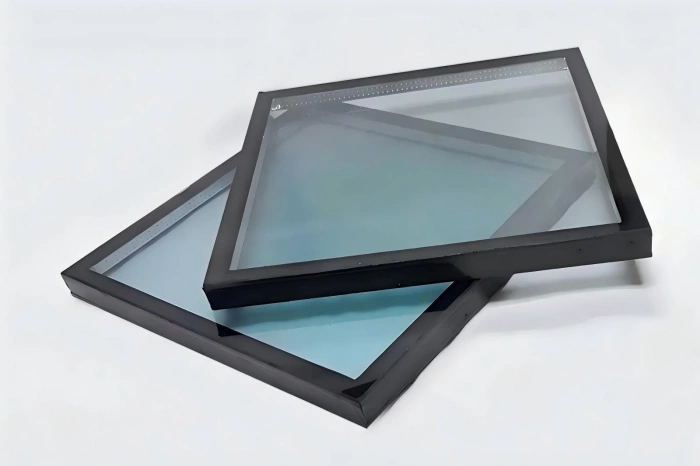
A glass-ceramic IGU (insulating glazing unit) is a composite glazing assembly that combines a transparent glass-ceramic inner pane — typically NEG Neoceram lithium aluminosilicate glass-ceramic — with a thermally toughened safety glass outer pane, separated by an aluminium-spaced air or argon cavity. The glass-ceramic pane handles direct exposure to heat sources up to 950 °C continuous service, while the toughened outer pane reduces operator-side surface temperature and adds mechanical protection. Engineers specify glass-ceramic IGUs for furnace observation windows, kiln viewing panels, biomass boiler doors, fireplace inserts and any application that requires continuous visibility under extreme thermal load.
This guide explains what a glass-ceramic IGU is, how it differs from ordinary insulating glass and tempered safety glass, the material properties that define its performance, and the industrial applications where it has become the standard high-temperature viewing solution.
Glass-ceramic IGU — at a glance
- What it is: Multi-pane insulating glass with glass-ceramic hot side + tempered safety glass cold side
- Inner pane material: Lithium aluminosilicate glass-ceramic (e.g. NEG Neoceram®, SCHOTT Robax®)
- Continuous service temperature: ≤ 950 °C
- Thermal expansion (0–750 °C): Near-zero, −1 × 10⁻⁷/K
- Fracture behaviour: Safe-fragment break — explosion-resistant
- Typical applications: Furnaces, kilns, biomass boilers, industrial ovens, fireplace inserts, reactor viewports
- Distinguishing from regular IGU: Regular IGUs are rated for building thermal insulation, not high temperatures. Glass-ceramic IGUs add 900+ °C capability.
What makes a glass-ceramic IGU different from regular insulating glass
A regular IGU (insulating glazing unit) — the kind installed in building windows — uses two or three panes of float or low-E glass separated by a spacer-filled gas cavity. These standard units block heat transfer for energy efficiency, but the float glass softens at approximately 600 °C and fractures from thermal shock well below that. Therefore, a regular IGU is unsuitable for any application where one side faces a flame, furnace chamber or molten material.
A glass-ceramic IGU replaces the hot-side pane with a transparent glass-ceramic — a material crystallised from a glass precursor through a controlled heat-treatment process. The result is a material with the optical transparency of glass and the thermal stability of ceramic. Specifically, glass-ceramic maintains structural integrity at temperatures that would liquefy ordinary glass and exhibits near-zero thermal expansion across the full service range. Moreover, the cold-side pane remains thermally toughened safety glass — the same material used in oven doors and side car windows — because it never reaches the extreme temperature of the inner pane.
Glass-ceramic IGU vs other glazing types
| Glazing type | Max. service temp | Thermal shock | Typical use |
|---|---|---|---|
| Float / low-E IGU | ~ 250 °C | Poor | Building windows, refrigerated displays |
| Tempered safety glass (single) | ~ 280 °C | Moderate | Oven doors, vehicle glazing |
| Borosilicate (DIN 7080) | ~ 280 °C continuous | Good | Pressure vessel sight glass |
| Glass-ceramic IGU | ≤ 950 °C continuous | 800 °C tested | Furnaces, kilns, biomass boilers |
| Fused silica / quartz | ~ 1100 °C | Excellent | Lamp envelopes, semiconductor process |
| Sapphire | ~ 1600 °C | Excellent | Extreme high-temp instrument windows |
Glass-ceramic occupies the sweet spot between borosilicate and pure quartz for industrial viewing applications. Specifically, it covers the 300–950 °C range where borosilicate fails and quartz is uneconomical. The IGU construction then turns a single-pane glass-ceramic — which is itself heat-resistant but hot to the touch — into an operator-safe viewing window by adding the insulating cavity and protective cold-side pane.
How a glass-ceramic IGU is constructed
A standard glass-ceramic IGU has three functional layers. From hot side to cold side:
Layer 1 — Inner pane (heat-facing glass-ceramic)
The inner pane is typically 5 mm of transparent lithium aluminosilicate glass-ceramic. The two industry-standard brands are NEG Neoceram® (Nippon Electric Glass) and SCHOTT Robax®. Both materials begin as a parent glass that contains a controlled fraction of nucleating agents. The manufacturer then ceramises the glass through a precisely scheduled heat treatment, growing β-quartz solid solution crystallites approximately 50–70 nm in size. Because the crystals are far smaller than the wavelength of visible light, the resulting material transmits light like glass but behaves thermally like ceramic.
Layer 2 — Aluminium spacer and cavity
A 16 mm aluminium spacer bar creates the insulating cavity between the two panes. The spacer typically contains a molecular sieve desiccant to keep the cavity dry, and the assembly is sealed at the edges with a dual-sealant system (primary butyl seal + secondary structural sealant). The cavity itself contains either dry air or argon — argon-filled cavities deliver slightly better thermal performance and are preferred for applications where the cold-side temperature must stay particularly low.
Layer 3 — Outer pane (cold-side toughened safety glass)
The outer pane is typically 6 mm thermally toughened safety glass. This pane never reaches the extreme temperature of the inner pane because the insulating cavity blocks most of the heat transfer. Moreover, the toughened safety glass adds mechanical impact protection and ensures that if any pane is struck or broken from the operator side, it fragments into small safe pieces rather than projectile shards.
The total assembled thickness for a standard unit is 27 mm (5 + 16 + 6 mm). Lumiglas’s standard glass-ceramic IGU is 1120 × 1120 × 27 mm; custom sizes — including circular, rectangular and small furnace-door panels — are produced on request.
The material: lithium aluminosilicate glass-ceramic
Glass-ceramic is not the same as ordinary glass. Specifically, it is a polycrystalline material produced by the controlled crystallisation of a parent glass. The two-stage manufacturing process is what gives it the unique combination of optical transparency and thermal stability.
How glass-ceramic is made
- Glass melting: The manufacturer melts a lithium aluminosilicate composition (Li₂O-Al₂O₃-SiO₂ system) with nucleating agents such as TiO₂ and ZrO₂. The melt is formed into the final shape — typically a flat sheet — and annealed.
- Nucleation: The annealed glass is reheated to a nucleation temperature (typically 700–800 °C). At this temperature, the nucleating agents form billions of microscopic crystal seed sites throughout the glass.
- Crystal growth (ceramisation): The temperature is raised further (typically 850–1000 °C) and held for a controlled time. β-quartz solid solution crystals grow from each seed site until the material is approximately 90% crystalline. Because the crystal size stays below ~70 nm — smaller than the wavelength of visible light — the material remains transparent.
- Cool down: The ceramised material cools to room temperature with no further heat treatment required.
Why near-zero thermal expansion matters
The β-quartz solid solution has an unusual property: it contracts slightly when heated, while the residual glass phase expands. The two effects nearly cancel each other, so the bulk material has a thermal expansion coefficient close to zero across a wide temperature range. Therefore, when a furnace door cycles from ambient to 800 °C and back, the glass-ceramic pane experiences almost no dimensional change — and consequently, almost no thermal stress.
By comparison, ordinary soda-lime float glass has a thermal expansion coefficient of 90 × 10⁻⁷/K, and borosilicate is 33 × 10⁻⁷/K. A 1 m glass-ceramic pane heated by 500 °C expands by less than 0.05 mm; an identical soda-lime pane would try to expand by 4.5 mm, which is why it cracks.
Typical glass-ceramic property values
| Property | Typical value |
|---|---|
| Continuous service temperature | ≤ 950 °C |
| Short-term peak temperature | ≤ 1000 °C |
| Thermal expansion (0–750 °C) | −1 × 10⁻⁷/K |
| Thermal shock resistance | 800 °C differential |
| Flexural (bending) strength | 170 MPa |
| Vickers hardness | 700 HV |
| Young’s modulus | 94 GPa |
| Density | 2.5 × 10³ kg/m³ |
| Refractive index | 1.54 |
| Acid resistance (90 °C, 24 h) | 0.05 mg/cm² |
Why glass-ceramic IGUs are called “explosion-proof”
The term “explosion-proof” in industrial sight glass refers to fracture behaviour, not to the prevention of pressure explosions. Specifically, an explosion-proof glazing assembly is one that, in the event of fracture under thermal or mechanical stress, does not produce dangerous projectile shards.
Ordinary annealed glass fails by propagating long sharp cracks across the pane — fragments can be flung several metres at high velocity. Tempered safety glass improves on this by fragmenting into small dice-like cubes when broken. Glass-ceramic goes further: the polycrystalline microstructure causes fracture energy to dissipate along grain boundaries, producing fine fragments that fall locally rather than projecting outward. Moreover, when a glass-ceramic IGU is installed in a furnace door, the toughened cold-side pane provides a secondary barrier — even in the very rare event of inner pane fracture, fragments are contained within the unit by the outer pane and edge seal.
For pressure equipment applications, this fracture behaviour satisfies the requirements of the European Pressure Equipment Directive (PED 2014/68/EU, Annex I §4.3 — transparent components subject to pressure). Therefore, glass-ceramic IGUs certified under PED are accepted as compliant viewing components on pressure vessels, autoclaves and reactor systems.
Where glass-ceramic IGUs are used
Industrial furnaces and heat treatment
The largest single application is observation windows on industrial furnaces and heat treatment ovens — particularly for steel annealing, aluminium melting, ceramic firing, glass tempering and metal hardening operations. Process operators need to monitor charge condition, flame quality and product appearance continuously without opening the chamber. Therefore, the IGU pane must remain transparent at the chamber’s operating temperature (often 600–950 °C) while keeping the operator side cool enough to approach safely.
Biomass boilers and combustion equipment
Biomass boilers — particularly wood-pellet and chip-fired systems — use glass-ceramic IGUs as flame inspection windows. Combustion regulators require operators to verify flame condition and fuel feed rate continuously. Moreover, the explosion-resistant fracture behaviour satisfies combustion equipment safety codes such as EN 303-5 and EN 12952 for biomass and steam boilers.
Kilns and ceramic firing
Pottery, brick, tile and refractory kilns operate continuously at 800–1200 °C. Glass-ceramic IGUs cover the lower half of this range as observation windows on intermittent kilns and tunnel kiln view ports. For higher-temperature kilns, sapphire viewports take over above 1000 °C.
Fireplace and stove inserts
Residential and commercial fireplaces, wood stoves and pellet stoves use single-pane glass-ceramic (not IGU) as the door glazing — the IGU construction is reserved for industrial applications where operator safety regulations require the cool-side outer pane. SCHOTT Robax® and NEG Neoceram® dominate the residential market under their brand names.
Process reactors and pressure vessels
Chemical reactors, autoclaves and high-temperature pressure vessels use PED-certified glass-ceramic IGUs as inspection viewports. The combination of pressure rating, high temperature capability and explosion-proof fracture behaviour makes glass-ceramic IGUs the only viewing technology accepted for many petrochemical and chemical processing applications above 300 °C.
How to choose a glass-ceramic IGU for your application
Five parameters drive specification of a glass-ceramic IGU for an industrial application:
- Maximum continuous service temperature on the hot side. Standard glass-ceramic IGUs are rated to 950 °C continuous. For higher operating temperatures, evaluate sapphire or quartz viewports instead.
- Required viewing area and frame geometry. Standard sizes are typically square (e.g. 1120 × 1120 mm). Smaller or rectangular custom sizes are produced on request — provide outer dimensions, the visible aperture required and the frame rebate depth.
- Pressure rating, if any. If the IGU will be installed in a pressure vessel rather than an atmospheric furnace, PED 2014/68/EU certification is required for use in the EU and is accepted as best practice globally.
- Cycling pattern. Equipment that cycles between ambient and operating temperature repeatedly (furnace doors that open every shift) puts more stress on the unit than steady-state operation. Glass-ceramic handles this well, but the frame and sealant must also accommodate the differential expansion.
- Chemical environment. Most applications expose the glass-ceramic to combustion gases, which it handles without degradation. For unusual chemistries (HF acid vapour, alkali metal vapour), confirm chemical compatibility with the manufacturer before specification.
For project-specific engineering — including frame design assistance, sealant recommendations and installation supervision — most manufacturers (including Lumiglas) provide technical support during specification.
Looking for a glass-ceramic IGU?
Lumiglas produces certified glass-ceramic IGUs for industrial furnace, kiln, biomass boiler and pressure vessel applications. Our standard 1120 × 1120 × 27 mm unit uses NEG Neoceram inner pane + thermally toughened safety glass outer pane, with PED 2014/68/EU, ISO 9001:2015, GJB 9001C:2017 and EJ/T 9001:2014 certifications. Custom sizes available on request.
Frequently asked questions about glass-ceramic IGUs
Material and construction
What does IGU stand for?
IGU stands for Insulating Glazing Unit (also called Insulating Glass Unit). The term describes a multi-pane glass assembly with a spacer-separated cavity between panes. Originally developed for building windows to reduce heat loss, the IGU concept now extends to industrial applications where the cavity isolates a hot-side glass-ceramic pane from a cooler operator-side pane.
What is glass-ceramic made of?
Glass-ceramic for high-temperature applications is typically a lithium aluminosilicate (Li₂O-Al₂O₃-SiO₂) composition containing nucleating agents such as titanium oxide and zirconium oxide. The material is first melted as a glass, then heat-treated to grow β-quartz solid solution crystallites approximately 50–70 nm in size. Because the crystals are smaller than the wavelength of visible light, the bulk material remains transparent.
Is glass-ceramic the same as Pyroceram, Neoceram or Robax?
Pyroceram, Neoceram and Robax are brand names for transparent lithium aluminosilicate glass-ceramic produced by Corning, Nippon Electric Glass and SCHOTT respectively. All three are similar materials with comparable thermal performance. Pyroceram was the original (introduced by Corning in 1958), while NEG Neoceram and SCHOTT Robax dominate the current industrial and residential markets.
Performance and comparison
What is the maximum temperature for a glass-ceramic IGU?
Standard glass-ceramic IGUs handle continuous service up to 950 °C and short-term peak temperatures up to 1000 °C — measured on the hot-side inner pane. Thermal shock tolerance is approximately 800 °C. For service above 1000 °C, sapphire or fused quartz viewports are typically specified instead.
Glass-ceramic vs tempered glass — what is the difference?
Tempered glass is ordinary soda-lime or borosilicate glass that has been thermally toughened by rapid surface cooling. It fragments safely on impact but softens at approximately 280 °C and cannot handle continuous high-temperature exposure. Glass-ceramic is an entirely different material — a partially crystallised glass — with continuous service capability above 900 °C and near-zero thermal expansion. Therefore, tempered glass suits oven doors and ambient safety applications, while glass-ceramic is required for furnace and combustion equipment viewing.
Is glass-ceramic IGU more expensive than borosilicate sight glass?
Yes — glass-ceramic IGUs typically cost several times more than equivalent-sized borosilicate sight glass discs due to the more complex manufacturing process and the multi-layer IGU construction. However, glass-ceramic is the only option for applications above approximately 300 °C continuous, where borosilicate cannot maintain mechanical integrity. For service below 280 °C, borosilicate remains the cost-effective choice.
Specification and installation
Can glass-ceramic IGUs be made in custom sizes?
Yes. Manufacturers including Lumiglas produce custom sizes on request — including rectangular, circular and small furnace-door panels. The minimum practical size is approximately 200 × 200 mm; the maximum depends on the supplier’s tempering oven and glass-ceramic sheet size, typically up to 1500 × 1500 mm in a single piece. Provide the required outer dimensions, the visible aperture, the frame rebate depth and the operating temperature for an accurate quotation.
Are glass-ceramic IGUs certified for pressure equipment?
Specific manufacturers’ glass-ceramic IGUs are certified under the European Pressure Equipment Directive (PED 2014/68/EU, Annex I §4.3) for use in pressure vessel viewing applications. Lumiglas glass-ceramic IGUs hold PED certification under LRQA (Notified Body 0343). For non-pressure applications (atmospheric furnaces, biomass boilers, fireplaces), PED certification is not required.
Which pane faces the heat source?
The glass-ceramic pane (inner pane) must always face the heat source. The cold-side toughened glass is not rated for direct high-temperature exposure and would crack rapidly if installed in reverse orientation. Manufacturers mark the glass-ceramic pane with a label that must be visible at the time of installation to confirm correct orientation.
References and further reading
- Höland, W. & Beall, G. (2019). Glass-Ceramic Technology, 3rd Edition. Wiley-American Ceramic Society.
- PED 2014/68/EU — European Pressure Equipment Directive, Annex I §4.3 (transparent components subject to pressure).
- EN 303-5 — Heating boilers for solid fuels. EN 12952 — Water-tube boilers.
- NEG Neoceram® technical reference: neg.co.jp
- SCHOTT Robax® technical reference: schott.com
- Lumiglas glass-ceramic IGU datasheet: High-Temperature Explosion-Proof IGU Datasheet (PDF)
Related Lumiglas products
- High-Temperature Explosion-Proof Glass — Glass-Ceramic IGU — Lumiglas’s standard production unit, 1120 × 1120 × 27 mm, PED certified.
- Aluminosilicate Sight Glass Disc — Alkali-free high-pressure round sight glass for 375 °C / 70 MPa applications.
- DIN 7080 Borosilicate Sight Glass — Standard pressure vessel sight glass for service up to 280 °C.
- Sapphire Glass Window — For extreme service above 1000 °C where glass-ceramic is insufficient.


